In brief
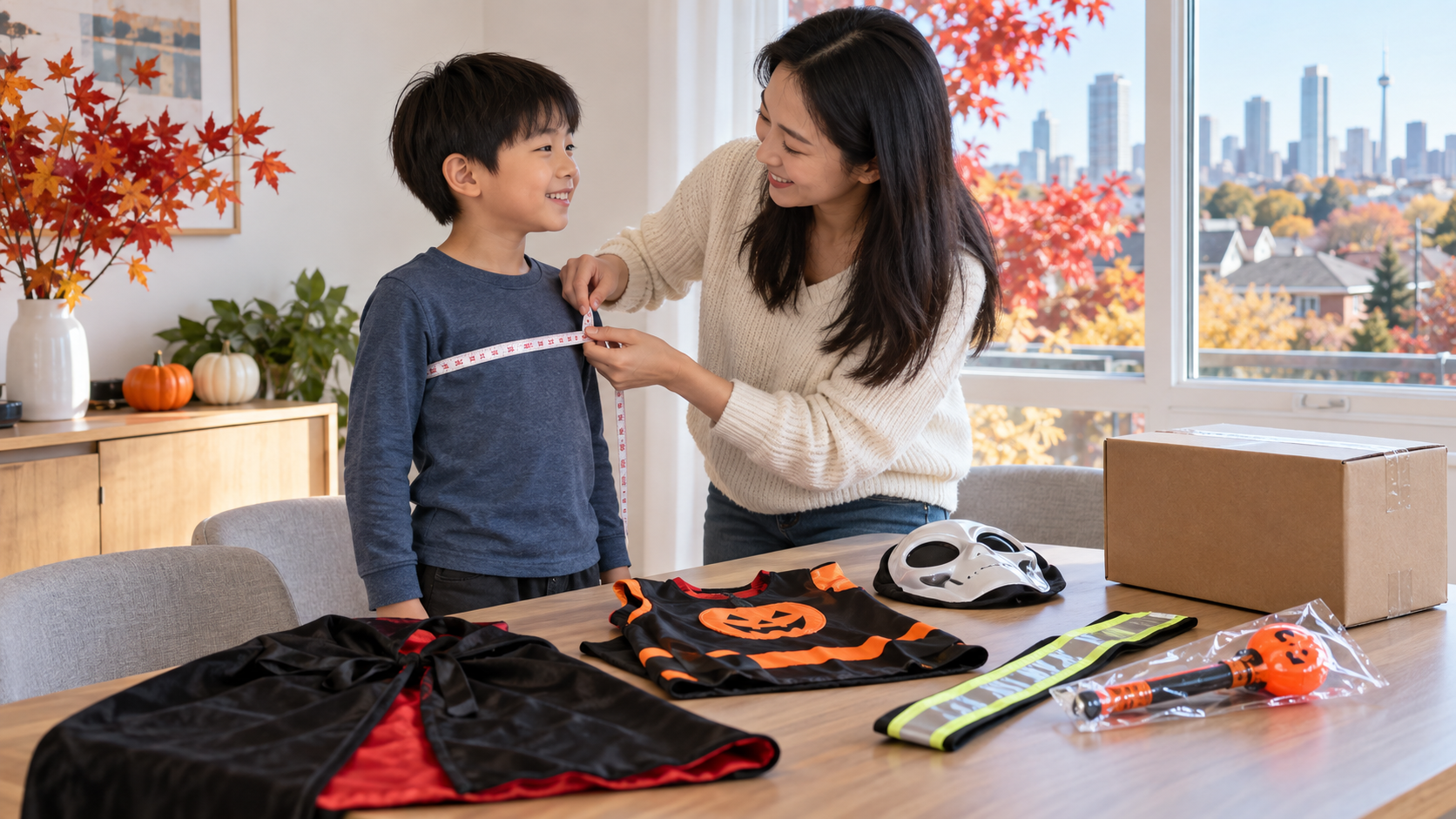
When shopping on Taobao for a child's Halloween event, a family party or a school activity in Canada, the biggest problems are rarely a lack of costume ideas. They are more often caused by choosing a size from age alone, buying a mask that restricts vision, overlooking a trailing cape, or discovering only after warehouse arrival that a light-up prop contains a battery that needs separate review. Measure the child before comparing listings, then check wearability, battery construction, cross-border transport details and the school's current-year notice as separate decisions.
Measure the child first, then read the seller's size chart
Children of the same age can differ in height, shoulder width and build, and sellers do not use a single standard conversion for age-based sizes. Before ordering, have the child wear the light base layer planned for the event, stand straight and breathe normally, then record the measurements in centimetres with a soft tape. The tape should be snug without squeezing or hanging loose.
First determine whether the seller's chart lists body measurements or garment measurements. Compare body measurements directly with the child's measurements. For garment measurements, lay flat a well-fitting item that still allows easy movement and compare like with like, leaving room for a warm layer and for raising arms, bending and using stairs. If the child falls between sizes, consider the cut, stretch, trouser-leg and cape length rather than automatically ordering one size larger.
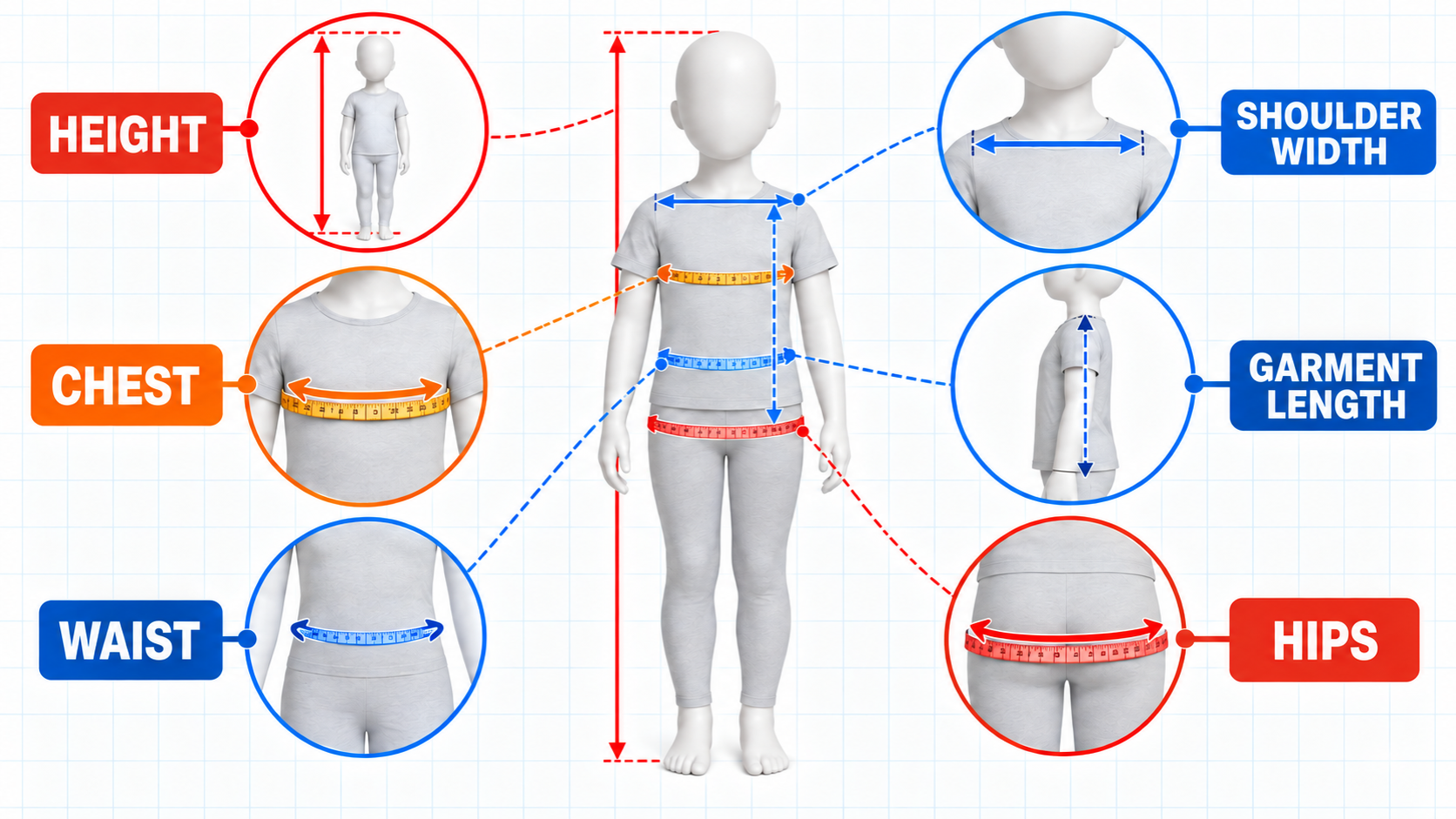
| Measurement | How to measure | What it helps you assess |
|---|---|---|
| Height | Without shoes, from the top of the head to the floor | Overall length of a one-piece costume, trouser length and whether a cape may trail |
| Chest | Keep the tape level around the fullest part of the chest | Breathing and movement room in tops, one-piece costumes and outer layers |
| Waist | Measure around the natural waist rather than using the trouser waistband | Waist fit and the proportions of a one-piece costume |
| Hips | Keep the tape level around the fullest part of the hips | Room through trousers, skirts and the lower half of a one-piece costume |
| Shoulder width | Measure from one shoulder point to the other | Shoulder seams, armholes and freedom to raise the arms |
| Garment length | Use a well-fitting garment and measure from the shoulder point to the hem | Whether the garment length in the seller's chart is suitable |
Put masks, capes and accessories through a movement test
Health Canada warns that long or loose costumes can lead to trips and falls, while a poorly fitting mask may obstruct vision and make breathing difficult. Once the costume arrives, do more than check it in a mirror. With adult supervision, have the child turn to look both ways, use stairs, sit down, raise their arms and walk quickly. Make sure the eye openings, nose and mouth area, shoe covers, hem, tail and cape do not interfere with movement.
For an evening outdoors, choose bright colours or add reflective tape or a reflective vest. Hand-held swords, forks or wands should be soft and flexible, without sharp edges. Health Canada also advises checking the weather on the day and bringing warmer clothing if the evening is expected to cool. A prop that is acceptable at a family party is not automatically permitted at school, so check the school's notice separately.
- Vision: the child can see straight ahead, to both sides and down at their feet, and the mask does not press on the nose or mouth
- Length: trouser legs, hems, capes and tails stay off the ground and do not catch on shoes or door handles
- Movement: the child can sit, bend, raise their arms and use stairs, and shoe covers do not slip
- Visibility: use bright or reflective materials at night and plan an appropriate warm layer
Official sources
Health Canada: Halloween safety (updated September 24, 2026)Makeup and fabric: hypoallergenic is not risk-free, and flame-resistant is not fireproof
When a mask would obstruct vision, Health Canada suggests considering face paint or makeup instead where appropriate, but it should still be patch-tested before use. Even a product labelled hypoallergenic can cause a reaction. Check the ingredients and intended age, and follow the product label for where and how it may be used. Decorative contact lenses should be purchased through a qualified eye-care professional, not treated as an ordinary costume accessory from a general online listing.
For fabric, Health Canada recommends materials that are less likely to catch fire, such as nylon or heavyweight polyester. Long, loose costumes and oversized wigs, beards, wings or tails are more likely to come into contact with a flame. A flame-resistant label does not mean that an item is fireproof. Whatever the label says, keep children away from candles, open-flame jack-o'-lanterns and other heat sources.
Check the battery compartment before buying a light-up prop
Light-up headbands, badges, wands, masks and flameless candles may use button batteries, another type of disposable battery or a rechargeable battery. The word LED does not identify the battery type. Before ordering, ask the seller to confirm the battery chemistry, model, quantity, whether the batteries are already installed and how the compartment opens. If the listing does not show this clearly, ask for the missing information rather than guessing after warehouse arrival.
Health Canada advises that light-up clothing and accessories used by children should have a child-resistant battery compartment that requires a tool or multiple steps to open. A swallowed button battery can cause severe internal chemical burns in as little as two hours, and used batteries remain dangerous. When the item arrives, an adult should check that every screw and latch is intact and immediately place spare and used batteries out of children's reach. If a child may have swallowed one, go to the nearest emergency department immediately and follow the directions of emergency professionals.
- Prefer a battery compartment secured by a screw or requiring multiple steps to open
- Do not let children install, replace or remove batteries
- For rechargeable products, use only the supplied charger or one recommended by the manufacturer
- Stop using and isolate a product that becomes hot, smells unusual, swells, leaks or stops working properly
A product title cannot determine how a battery item must be transported
Transport Canada classifies lithium batteries as dangerous goods. A battery shipped on its own, one packed with equipment but not installed, and one contained in equipment are different transport configurations. Batteries must be declared accurately to the postal operator, courier or transport company when they are shipped or imported, and the applicable requirements vary with battery chemistry, configuration, energy rating, quantity and mode of transport. Health Canada also notes that button- or coin-shaped batteries can use lithium, alkaline, silver-oxide or zinc-air chemistries, so button battery and lithium battery are not interchangeable terms.
This does not mean that every battery-powered Halloween prop is barred from air transport. Keep the seller's information about the battery model, whether it is installed and its watt-hour rating where applicable, then ask Cainiao which current routes accept the actual item once it reaches the warehouse. Damaged, defective, recalled or end-of-life lithium batteries are prohibited from air transport. If the casing is damaged, the battery is swollen or the item produces unusual heat, do not consolidate it with ordinary clothing.
- Before ordering, ask the seller whether the item contains a battery and confirm its chemistry, model, quantity, installed status and watt-hour rating where applicable.
- Check the item's current restricted-goods status and available routes in the Cainiao App or mini program instead of relying on an earlier order.
- Declare the battery characteristics accurately. If they remain unclear, send the product link and battery photos to support for review.
- After warehouse arrival, review the inspection information and packaging condition, then let the current route and warehouse review determine whether the item can ship.
There is no single Canada-wide rule for Halloween costumes at school
Schools and school boards set current-year requirements according to grade level, planned activities, safety and the needs of their communities. Official notices from earlier years show how details can differ. For a 2025 kindergarten event, Calgary Board of Education's William Reid School allowed costumes but prohibited weapons, masks, blood and gore. That year, TDSB's Northern Secondary School welcomed students to a Halloween Spirit Day while reminding families not to turn cultural identities, traditions or sacred symbols into stereotyped costumes. These are past examples, not Canada-wide rules for 2026.
Before buying for a school event, look for the child's school's or school board's 2026 email, family newsletter, calendar or class notice. If it has not been issued, ask the classroom teacher or school office. In particular, confirm whether masks, toy weapons, light-up or sound-making props, makeup and shared food are permitted; whether the costume must be worn over regular clothes; and which grades, times and weather arrangements apply.
- Do not treat another school's previous-year practice as your school's current rule
- Confirm whether the activity takes place during lessons, includes gym or outdoor time, or requires a change of clothes
- For cultural, religious or community symbols, follow the school's respect and inclusion guidance
- If the notice remains unclear, ask the classroom teacher or school office before ordering
At the warehouse: review clothing, fragile decorations and battery items separately
Once the parcels reach the warehouse, review them by product type before deciding what can go into the same shipment. Separately here means checking size, condition, battery characteristics, packaging and route eligibility as distinct questions. It does not promise that the warehouse will physically box each category separately. Whether products can use the same route, or require unpacking or reinforcement, depends on the live order page, warehouse review and support's response.
- Match every item against the Taobao order and warehouse check-in record, listing clothing, fragile products and battery-powered items as three groups.
- Resolve size errors, damage, missing parts, unclear battery details or a mismatch in item classification first.
- Do not hide a battery item in a clothing description. Declare its actual characteristics and retain confirmations from the seller and support.
- Choose only routes and services currently offered on the order page. Before paying, recheck the parcels, chargeable weight, declaration, add-on services and final total.
| Group | What to check first at the warehouse | What to confirm before consolidation |
|---|---|---|
| Clothing and textiles | Size, colour, quantity, stitching, zippers, and cape and trouser-leg length | Whether the item contains a light-up component and whether it matches the seller's size chart and the order |
| Fragile decorations | Cracks, chips, sharp edges, inner and outer packaging, and empty space | Currently available inspection or reinforcement services, packed volume and route restrictions |
| Battery-powered items | Battery type and model, installed status, compartment and casing for every SKU | Accurate declaration, product condition and acceptance on the current route |
Before paying for international shipping
If a Promo Code field appears at international-shipping checkout, enter CANADA for a 10% discount;
confirm that it has been applied before paying. Eligible routes, conditions, validity and stacking are controlled by the live checkout page.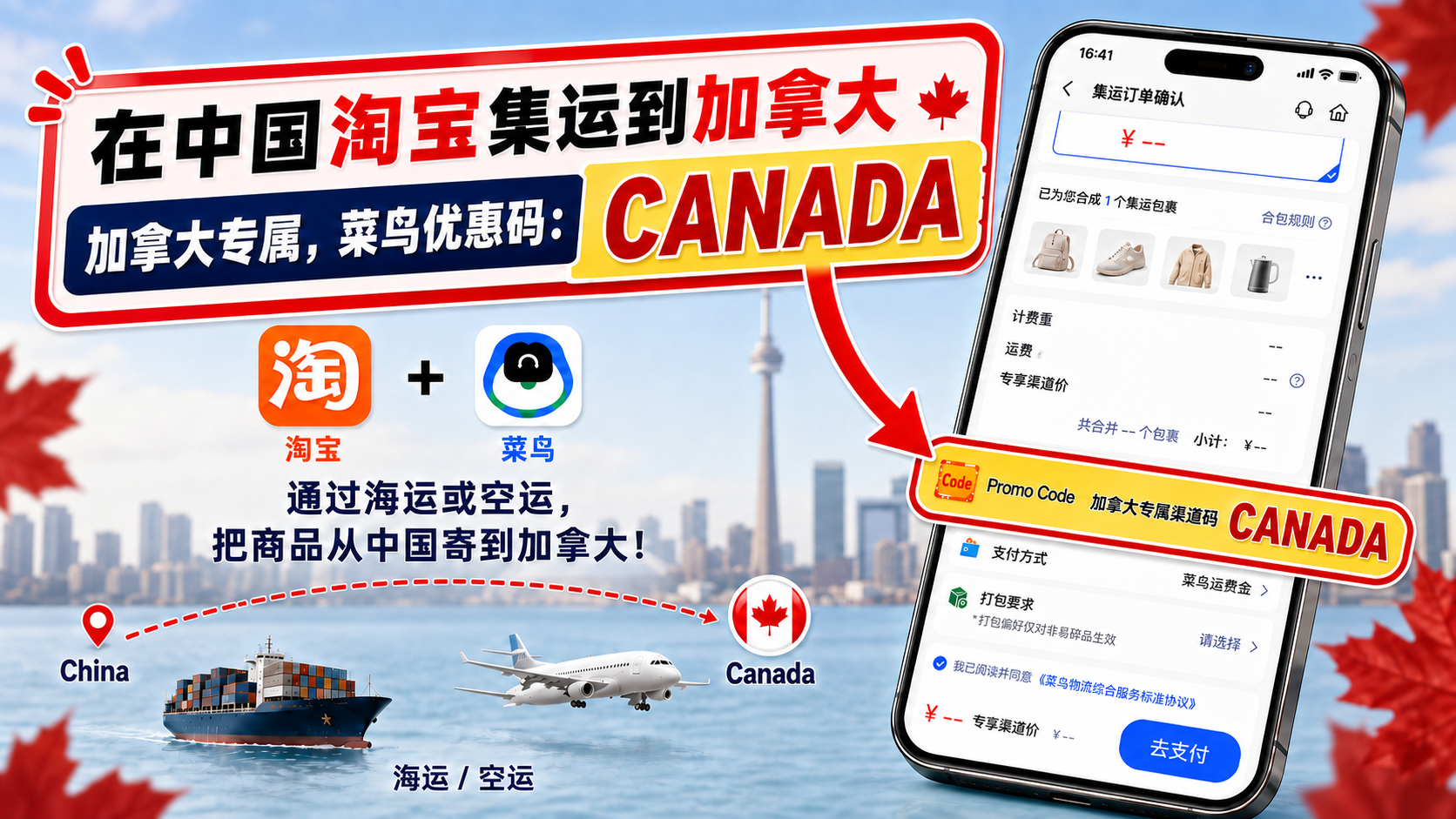
Independent guide. Recheck current rates, routes, estimates and item restrictions on the live order page before payment.